
Cordless Drill Torque Ratings: Nm vs UWO for Canadian Buyers
Can a drill rated in unit watts out beat one advertising a large torque number? Those figures alone cannot answer the question. Torque describes a turning effect; UWO describes power output. They measure different quantities, so there is no fixed conversion from Nm to UWO.
This guide explains how to read both ratings without inventing a performance comparison. It is based on manufacturer documentation and measurement references. We have not physically tested the drills mentioned here.
Affiliate disclosure: FairyReviews may earn a commission from qualifying purchases through affiliate links, at no additional cost to you. This guide contains no direct purchase links. See our Affiliate Disclosure for details.
What the numbers mean
| Published figure | What it describes | What it does not establish by itself |
|---|---|---|
| Torque in N·m, often written Nm | Turning effect at the stated measurement point and conditions | Drilling speed, runtime or a particular screw’s final tightening torque |
| Torque in in-lb | The same type of quantity, expressed in pound-force inches | A directly comparable result when manufacturers use different tests |
| UWO, or unit watts out | DEWALT’s rating of maximum drill-system output power | A torque value or the battery’s energy capacity |
| No-load RPM | Rotational speed without the working load | Speed while boring a hole or driving a screw |
NIST identifies the newton metre as a torque unit and the watt as a power unit. Different labels are not interchangeable simply because both sound like measures of strength. NIST’s SI reference distinguishes these quantities.
What DEWALT means by UWO
DEWALT describes UWO as maximum output power for the drill system, measured at the chuck and accounting for the transmission, clutch and chuck. This is the manufacturer’s explanation of its rating, rather than an independent certification of every drilling task. See DEWALT’s UWO explanation.
Battery conditions matter when interpreting the claim. A separate DEWALT support note gives its DCD996 example as 820 UWO with a DCB205 5Ah battery. That is a documented example, not a recommendation to buy that model or a promise of its output with another battery.
Use the exact model’s footnotes. A headline rating is less useful when the tested battery or comparison model is missing.
Why there is no Nm-to-UWO conversion
For a rotating shaft, mechanical output power depends on torque and the speed at which that torque is being delivered. Expressed with torque in N·m and speed in RPM:
Power in watts = torque × RPM × 2π ÷ 60.
Oriental Motor’s engineering explanation gives the equivalent rounded multiplier, 0.1047, and specifies torque and speed at the same operating point. Its page concerns motor output; the physics explains the missing information, but does not reproduce DEWALT’s drill testing protocol.
Consider two hypothetical operating points:
- 20 N·m delivered at 300 RPM produces approximately 628 watts.
- 10 N·m delivered at 600 RPM also produces approximately 628 watts.
These are arithmetic examples, not measurements of a drill or predictions of its UWO. The same power can accompany different torque values.
Do not multiply a drill’s advertised peak torque by its advertised no-load RPM. Those numbers do not establish that the tool delivers both simultaneously. Likewise, dividing UWO by no-load RPM does not reveal maximum torque. A credible comparison needs the operating conditions and measurements under load.
The conversion you can make: in-lb to Nm
Pound-force inches and newton metres both measure torque, so changing units is valid:
N·m = in-lb × 0.1129848.
For example, 500 in-lb is approximately 56.5 N·m. NIST’s conversion table supplies the factor.
This changes the unit, not the test. Preserve labels such as maximum, hard-joint or soft-joint torque when they appear. A unit conversion cannot make differently defined manufacturer claims into a controlled comparison. Also check that the listing says inch-pounds rather than foot-pounds; those units differ by a factor of twelve.
Two real claims, read carefully
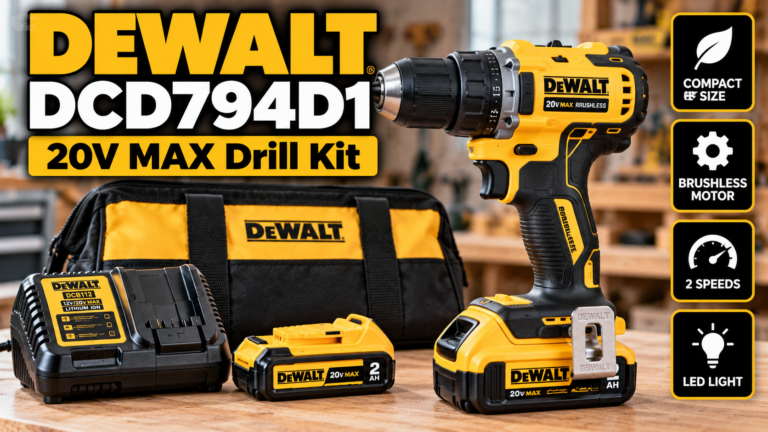
The Canadian DCD800P1 page claims up to 40% more UWO than the DCD791B, with a DCB205 battery specified in the comparison. That is a comparison between specified DEWALT setups. It does not mean 40% more torque, battery runtime or drilling speed in every material.
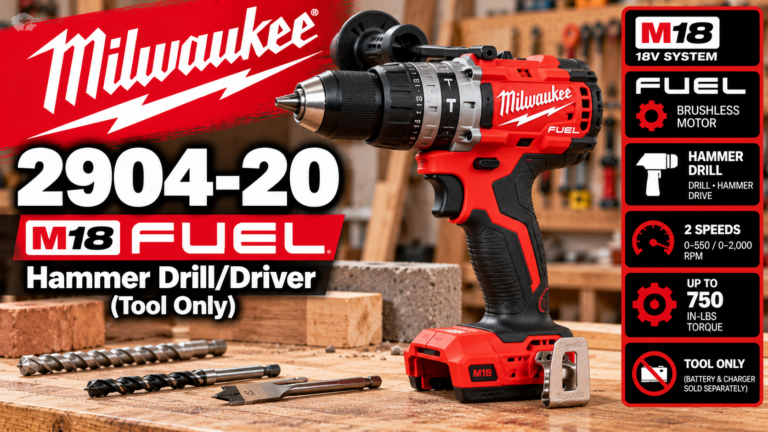
The Canadian Milwaukee 2904-20 page lists 1,400 in-lb of torque. Converting that torque to Nm would not make it comparable to DEWALT’s percentage power claim. Neither statement alone establishes a winner for your job.
Our DCD800P1 kit guide and 2904-20 guide cover their respective package and model details.
A more useful buying checklist
- Define the work. Record the material, hole diameter and fastener type. Check the manual’s permitted applications and capacities before comparing headline ratings.
- Match the tool type. Decide whether you need a drill/driver, hammer drill or impact driver. Our tool-type guide explains the choices.
- Keep the conditions attached. Save the exact model, battery, rating label and footnote beside each number. Mark undisclosed conditions as unknown.
- Compare a complete Canadian setup. Include compatible batteries, charger, tax, delivery eligibility and seller terms. Use our kit-cost checklist.
- Look for evidence of the actual task. A useful performance comparison states the bit, material, battery and procedure. A large specification number cannot replace that evidence. Weight, access and control also affect whether the setup suits you.
Does a higher torque rating make a drill better?
It may help identify tools worth investigating for demanding work, but it is only one published specification. For occasional household holes and screws, first check that the tool supports the intended application and that the complete setup fits your needs. For repeated demanding holes, seek clearly documented task testing and the manufacturer’s operating limits. Nm, in-lb and UWO help describe a tool; they do not determine the purchase on their own.
Sources checked 21 October 2026. Model claims and specifications can change; confirm the exact product page and footnotes when comparing tools.

2 Comments