
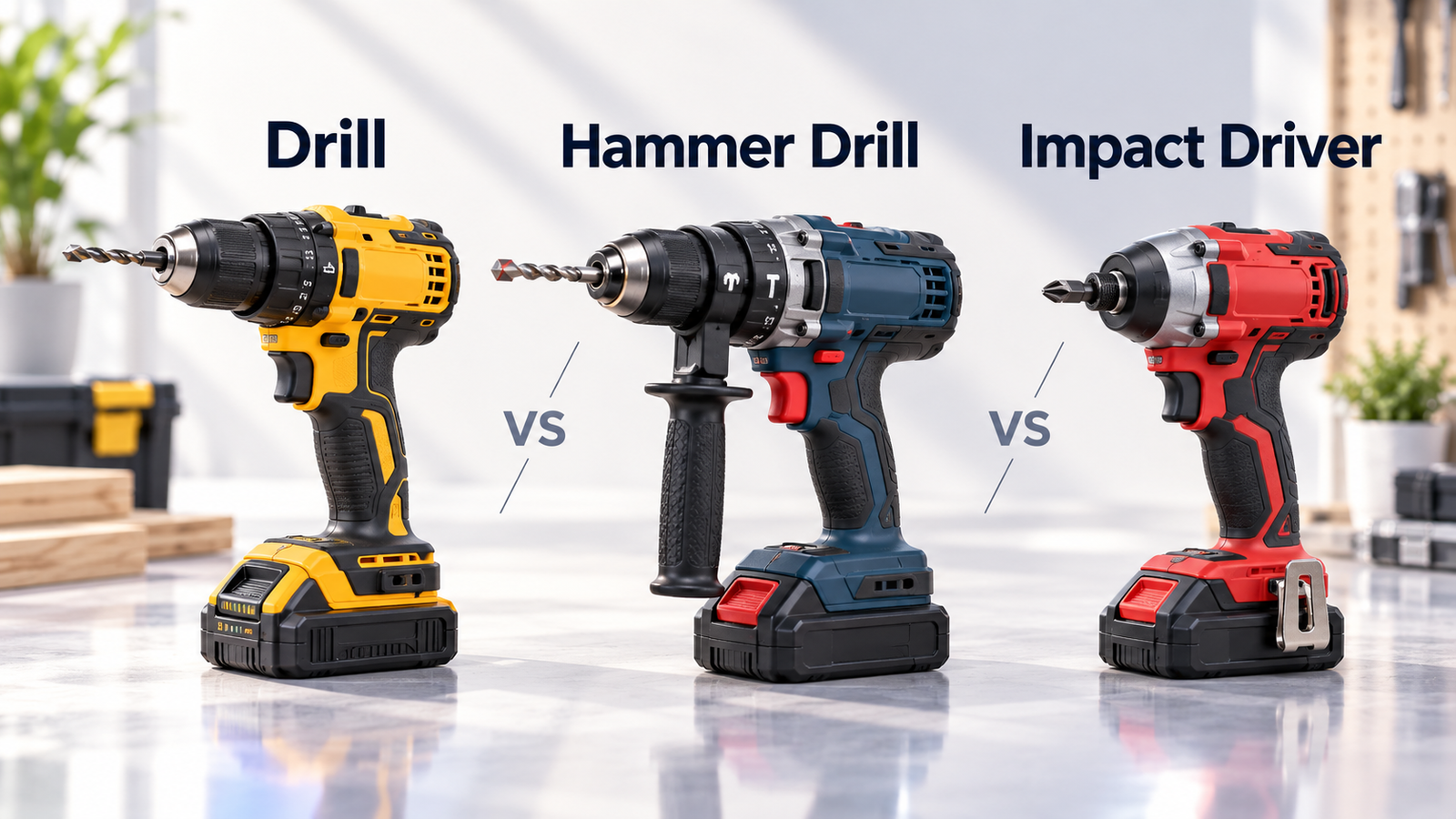
Drill vs. Hammer Drill vs. Impact Driver: What to Buy in Canada
Disclosure: Fairy Reviews may earn a commission from qualifying purchase links. This research-based guide contains no affiliate purchase links, and the tools discussed here were not hands-on tested by us. It explains the differences using manufacturer documentation.
For most household projects, start with a drill/driver. Add a hammer-drill mode when you need to make smaller holes in masonry, or choose an impact driver when you regularly drive long screws and other fasteners. These tools can look similar, but they are built to do different jobs.
For more detail, start with our Power Tools Canada hub, then read the guides on choosing a cordless drill, 18V vs. 20V MAX labels, and comparing kit costs.
Quick comparison
| Tool | Best fit | What to look for | Main trade-off |
|---|---|---|---|
| Drill/driver | Everyday holes and controlled screw driving in wood, metal and other suitable materials | Keyless chuck, variable speed and adjustable clutch | Does not add the hammer action used for masonry drilling |
| Hammer drill/driver | General drilling plus occasional holes in brick, concrete or other masonry when the manual and bit allow it | A mode selector that can turn hammer action off, plus a compatible masonry bit | Usually larger or heavier than a basic drill/driver; hammer action is unnecessary for ordinary wood drilling |
| Impact driver | Driving screws and fasteners, especially repetitive or more demanding fastening | 1/4-inch hex collet, variable trigger and speed/drive settings | Less suited to controlled, round-shank drilling and delicate screw work |
What a drill/driver does
A drill/driver rotates a bit or drill accessory and gives you a chuck that can hold different shank styles. For screw driving, its adjustable clutch helps limit how far the tool continues to turn after resistance rises. That combination makes it the most flexible first cordless tool for shelves, furniture assembly, pilot holes and common repair jobs.
Use the clutch for screws rather than leaving the tool in unrestricted drill mode. Start with a low setting on scrap material, then raise it only as needed. The exact clutch behaviour and bit capacity depend on the model, so follow its manual.
When the hammer-drill mode matters
A hammer drill/driver combines ordinary rotation with a forward percussion action. Bosch describes its hammer-drill mode as intended for drilling in concrete, asphalt, tile and similar hard materials. That mode is for drilling; it is not the same as an impact driver’s rotational impacts while fastening.
If you mostly drill wood or metal, a standard drill/driver is enough. If a project includes occasional small masonry holes, a hammer-drill/driver can cover both roles. Use a masonry-rated bit and check the tool manual for material limits. For frequent or substantial concrete drilling, compare a dedicated rotary hammer and the correct bit system instead of assuming a compact hammer drill is the right tool.
When an impact driver makes sense
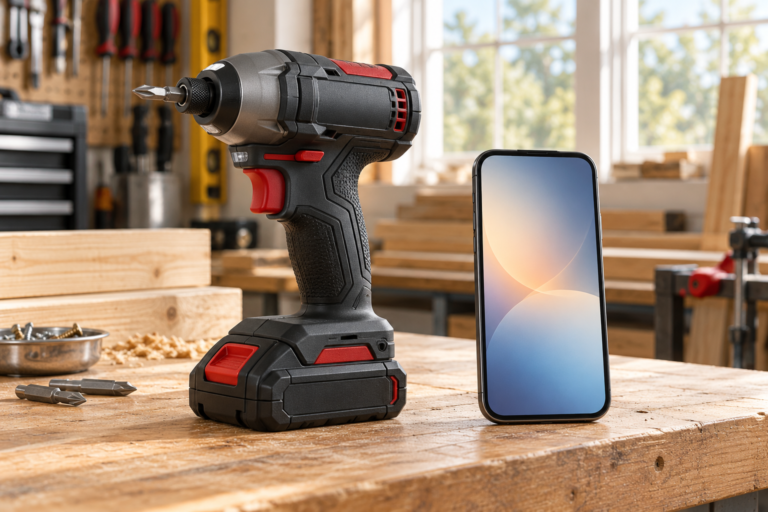
An impact driver uses a hammer-and-anvil mechanism to deliver rotational impacts for fastening. Bosch notes that its impact drivers use a 1/4-inch hex collet and are primarily designed for fastening, while a regular drill is more versatile for general-purpose drilling. Some hex-shank drill bits can be used in an impact driver, but that does not make it a replacement for a chuck drill when you need accurate holes or round-shank bits.
Choose one if you often drive deck screws, structural fasteners or many repeated screws. For small cabinet screws and delicate materials, the impact action can be too aggressive unless you have a well-controlled model, suitable bit and careful trigger technique. Test on scrap and stop if the fastener or workpiece begins to deform.
Do you need one tool or two?
- One tool for general home use: choose a drill/driver with an adjustable clutch and a chuck that accepts the bits you expect to use.
- Occasional masonry holes: consider a hammer-drill/driver if its size, weight and manual suit your work.
- Frequent fastening: add an impact driver for speed and convenience, while keeping a drill/driver for holes and controlled screw work.
- Frequent concrete drilling: compare rotary hammers and their accessories; check manufacturer guidance for the material and hole size.
Some two-tool combo kits pair a 1/2-inch hammer drill/driver with a 1/4-inch impact driver. For example, DEWALT Canada lists that pairing in its DCKTS299P2 kit, while Makita Canada’s DLX2020SY listing specifies a hammer drill/driver, impact driver, two batteries, charger and case. These are examples of kit configurations, not product rankings; verify the exact model and included items at the time you shop.
Buying checklist
- List the materials, hole sizes and fasteners you actually expect to use.
- Check the tool’s exact model number, chuck or collet, modes and compatible accessories.
- Compare weight with the battery attached, grip and speed controls if you can handle the tool in person.
- Check the kit contents and Canadian warranty terms, not just the headline voltage or “combo” label.
- Use manufacturer instructions, eye protection and the correct bit; keep hands clear of rotating accessories.
Manufacturer references
- Bosch: cordless impact drivers and how they differ from drills
- Bosch: cordless hammer drill/drivers and masonry applications
- DEWALT Canada: DCKTS299P2 combo-kit details
- Makita Canada: DLX2020SY kit contents
Specifications, included accessories and warranty terms can change by model and market. Confirm the current manufacturer page and manual before purchase.
8 Comments